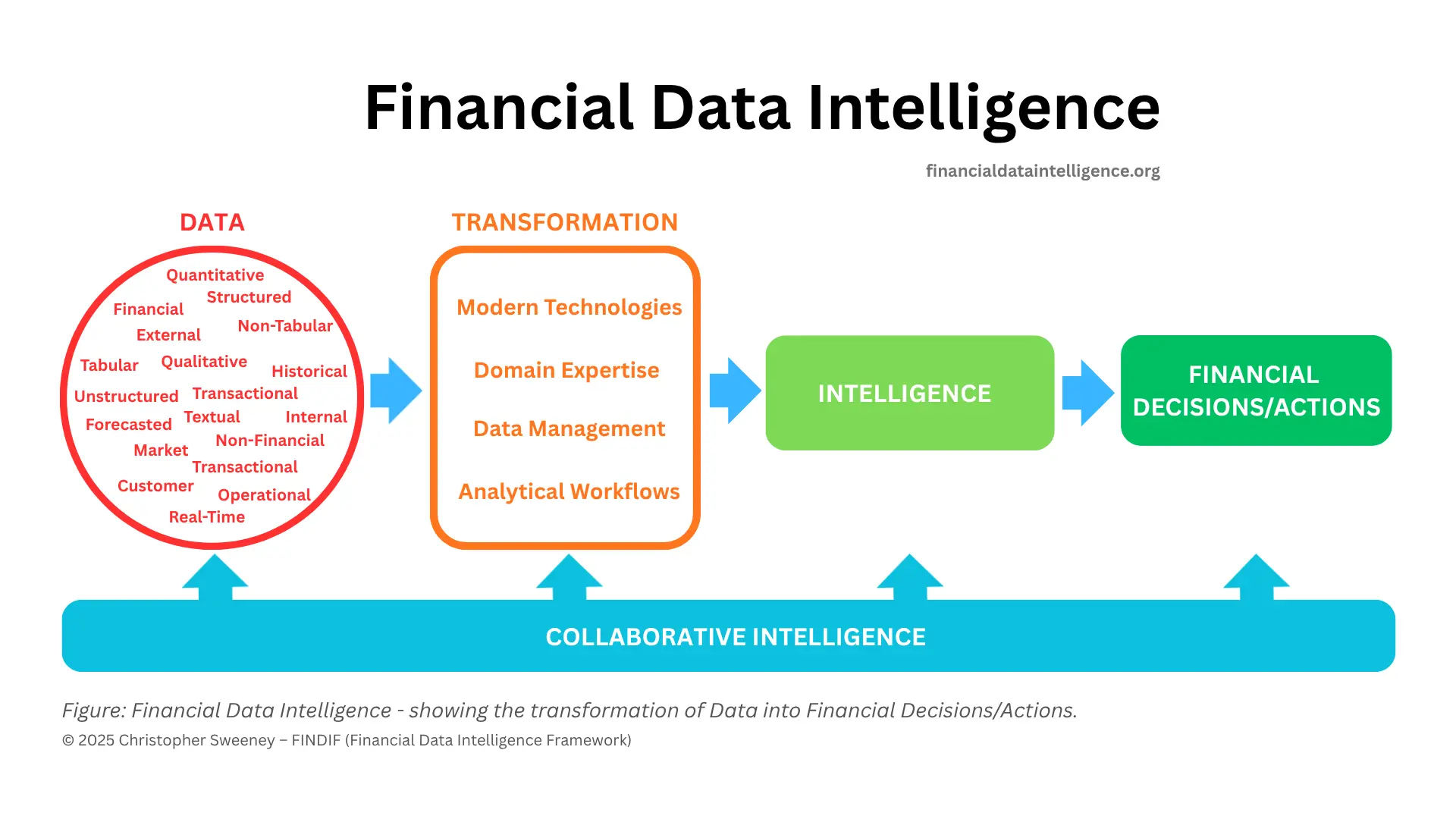
Financial Data Intelligence is the practice of leveraging
modern technologies, including AI and advanced analytics, to transform data into actionable intelligence, empowering
organisations to make smarter, faster, data-driven financial decisions.
Financial Data Intelligence (FDI) is the practice of transforming data into actionable intelligence for financial
decisions and actions. It combines domain expertise (both human and artificial) with modern technologies, robust
data management, and analytical workflows to produce intelligence that empowers organisations to make smarter,
faster, and more confident financial decisions.
At its core, FDI represents a new era of collaborative intelligence - where human judgment and artificial
intelligence work together to extract meaning from data. This fusion creates a continuous cycle of learning,
analysis, and decision-making, connecting data, technology, and reasoning into a single, intelligent financial
ecosystem.
By leveraging FDI, organisations move beyond traditional analytics and reporting. They gain the ability to act on
insights that were previously difficult or impossible to uncover, unlocking a step-change in financial
decision-making powered by AI, advanced analytics, and domain expertise.
In today’s fast-moving world, organisations that fail to embrace modern technologies and methods to create
actionable intelligence for strategic decisions risk obsolescence - falling behind in speed, insight, and
competitive advantage.
Financial Data Intelligence (FDI) changes the game. It is not a single tool, skill or an ad-hoc use of AI - it is an
integrated, organisation-wide capability. From data collection and management to analysis, insight generation, and
decision-making, FDI embeds intelligence at every stage of the journey. Human expertise and AI work together
continuously, creating a system that learns, adapts, and amplifies decision-making across the finance function.
By adopting FDI, organisations gain more than efficiency - they gain a decisive advantage. Teams become skilled in
modern technologies, workflows become smarter, and insights emerge that were previously impossible to uncover. They
can act faster, reduce risk, seize hidden opportunities, and drive strategy with confidence.
FDI is not incremental; it is transformative. Organisations that embrace it move beyond reactive finance. They do
not merely survive in the modern landscape - they redefine what it means to make intelligent, timely, and confident
financial decisions, leaving competitors who rely on traditional approaches at a strategic disadvantage.
AI: The Engine of Financial Data Intelligence
For organisations today, Artificial Intelligence is no longer optional. For years, finance teams have built
predictive models, dashboards, and reports to understand the past and anticipate the future - but these systems have
always relied on human time, manual logic, and static rules.
In many organisations, analysts now use AI in ad-hoc ways - copying data into public tools, generating models
without validation, or experimenting in isolation. This fragmented approach introduces risk, inconsistency, and
compliance concerns.
Using AI effectively in finance requires more than experimentation; it demands structure, governance, and purpose.
Financial Data Intelligence provides that foundation.
FDI offers a structured methodology for embedding AI into secure, well-managed financial workflows - where
data quality, transparency, and accountability are built in from the start.
In FDI, AI is not a replacement for human expertise; it is an amplifier of it. Properly embedded, AI enhances
forecasting, detects patterns humans might miss, and continuously learns from change. Within FDI, AI is part of the
financial nervous system - monitoring, analysing, and responding in real time.
The organisations that thrive, now and in the future, will be those that fully embrace AI - not recklessly, but
responsibly. Financial Data Intelligence provides the methodology to make that possible: uniting
human insight, robust data management, and intelligent automation into a single, trusted ecosystem.
Collaborative Intelligence
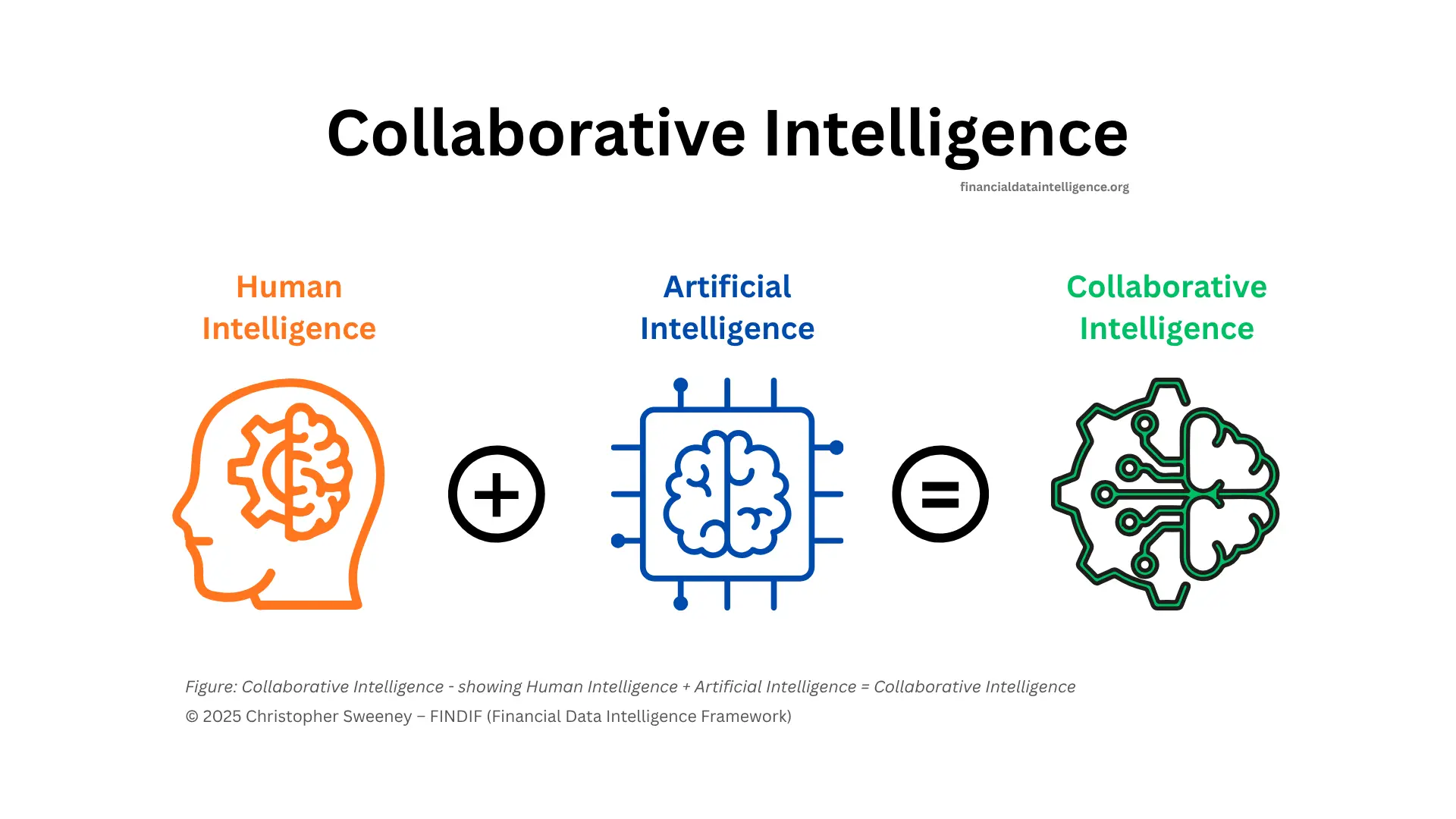
Collaborative Intelligence lies at the heart of Financial Data Intelligence. It is the partnership between human
expertise and artificial intelligence - a fusion of reasoning, creativity, and computation. By aligning human
judgment with machine precision, organisations can transform raw data into deeper insights, smarter strategies, and
faster decisions.
In this partnership, humans provide context and conscience; AI provides scale and speed. Together, they create a new
standard of intelligence - one that learns, adapts, and acts with purpose.
Today, expertise no longer refers exclusively to humans; decisions and actions may be made or executed by AI,
humans, or a combination of both.
Financial Data Intelligence is where Finance meets Collaborative Intelligence, uniting human and artificial
competencies to transform diverse data into actionable financial intelligence.
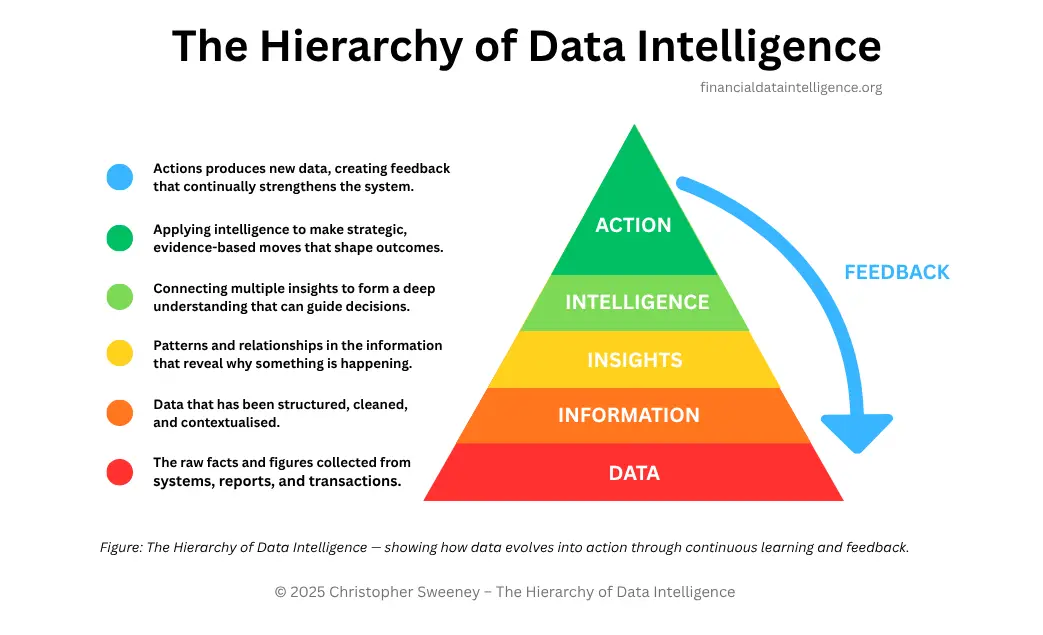
Financial Data Intelligence isn’t static - it evolves through a continuous cycle of learning and refinement.
The Hierarchy of Financial Data Intelligence illustrates how raw data matures into informed, intelligent
action, before looping back through feedback to drive improvement. Each level strengthens the next, turning
insight into measurable impact and making organisations progressively smarter with every iteration.
1. Data - The Raw Material
Every organisation generates vast quantities of data: transactions, market feeds, operational logs, customer
behaviour, and external indicators. But data alone is inert. It’s the unrefined ore of intelligence -
valuable only when structured, cleaned, and contextualised.
“Without data, there is nothing to analyse. Without context, there is nothing to understand.”
2. Information - Organised and Contextualised
When data is collected, categorised, and given context, it becomes information. Patterns start to emerge:
revenues by product, costs by department, or trends over time. At this stage, information helps describe what
is happening.
“Information is data that has been made readable, relatable, and relevant.”
3. Insight - Understanding Why
Insight connects cause and effect - revealing why something happened. It often emerges through analytics,
AI models, and expert interpretation. This is where human and machine collaboration truly begins, turning
numbers into narratives.
“Insight is the bridge between knowing and understanding.”
4. Intelligence - Knowing What to Do
Intelligence transforms understanding into decision-ready guidance. It answers the critical question:
What should we do next? This level synthesises insights, risk assessment, and predictive modelling into a
single, actionable view.
“Intelligence informs choice - it gives clarity, direction, and confidence.”
5. Action - Applying Intelligence
The true purpose of Financial Data Intelligence is not just to know - but to act. Action turns intelligence
into measurable impact. And even inaction,
when deliberate, is still a strategic choice derived from intelligence.
“Wisdom is not the end state - action is.”
6. Feedback - Learning and Evolution
After action comes reflection. The outcomes of every decision feed back into the data layer, closing the loop.
This feedback enables learning, refinement, and adaptation - turning FDI into a living system that continuously
improves.
“Every decision creates new data. Every new data point refines future intelligence.”
The Hierarchy of Financial Data Intelligence is not linear - it is circular. Each iteration strengthens the next,
making decisions smarter, faster, and more aligned with organisational goals.
Financial Data Intelligence (FDI) replaces traditional approaches to data management, transforming static processes
into a living, adaptive system of actionable intelligence. It is not a static workflow - it is a continuous,
AI-powered cycle where human expertise, advanced analytics, and intelligent automation work together to turn
information into strategic advantage. Organisations that embrace FDI can anticipate change, act decisively, and make
smarter, faster, and more confident financial decisions.
The 5 key stages of FDI are:
Collecting Data – Building the Intelligence
Foundation
Organisations practising FDI integrate financial, operational, and external data from diverse, often disparate
sources. Humans and AI collaborate to determine which data is needed, ensure quality and relevance, and bring it
together into coherent structures for analysis. The focus is on intelligent curation and orchestration, creating
a foundation for meaningful insights and informed decisions.
Transforming Data – From Raw to Relevant
Humans and AI work together to clean, enrich, and contextualise the data. Patterns, anomalies, and correlations
emerge automatically, revealing insights that traditional analytics would miss. Governance, transparency, and
accuracy are embedded at every step.
Generating Intelligence – Insight in Motion
Transformed data is synthesised into actionable intelligence through dynamic dashboards, predictive models, and
continuous streams of evolving insights. This intelligence is always connected to organisational priorities, not
just historical reporting.
Insights are delivered where and when decisions are made. Humans and AI collaborate to make faster, smarter
choices - whether reallocating capital, adjusting forecasts, managing risk, or seizing market opportunities.
Every action is informed, deliberate, and measurable.
Feedback & Learning – The Cycle Evolves
Every decision feeds back into the system, creating new data and refining future intelligence. The FDI cycle
continuously adapts, learns, and evolves, making organisations progressively smarter, more agile, and better
equipped to respond to change.
In essence, FDI turns data into a living resource - an adaptive engine of insight and action. The result is a
financial function that is not just reactive, but proactive, predictive, and perpetually improving, delivering a
decisive advantage in a world where speed, accuracy, and insight define success.
Financial Data Intelligence is for any organisation, team, or individual that relies on financial data to make
strategic decisions. It is not a tool or software, but a capability and practice that enables people to produce
better intelligence - turning raw, disparate data into insights that support faster, smarter, and more confident
decisions.
Key groups that benefit from FDI include:
1. Executives and Leadership Teams
Challenge: Fragmented or delayed data makes strategic decisions slower, riskier, and less
confident. Solution: By applying FDI practices, leaders can synthesise complex financial and operational
information into coherent, actionable intelligence. Impact: Faster, more informed strategic decisions, reduced risk, and the ability to seize growth
opportunities.
2. Finance and Accounting Teams
Challenge: Manual processes, siloed systems, and inconsistent reporting consume time and limit
strategic focus. Solution: FDI practices allow teams to structure, integrate, and analyse data efficiently, producing
reliable insights. Impact: More time for scenario planning, decision support, and driving value across the organisation.
3. Investment and Quantitative Teams
Challenge: Rapid market changes, complex instruments, and vast data volumes make insight generation
slow and error-prone. Solution: Collaborative human + AI workflows help these teams identify patterns, model scenarios, and
generate richer insights. Impact: Improved ability to anticipate market moves, manage risk, and capture opportunities.
4. Operational Managers
Challenge: Disconnected financial and operational datasets make it difficult to produce actionable
insights. Solution: FDI frameworks guide the curation, integration, and analysis of diverse datasets, supporting
more accurate and relevant intelligence. Impact: Analysts can deliver insights that meaningfully inform decisions across finance, operations,
and strategy.
5. Operational Managers and Cross-Functional
Leaders
Challenge: Lack of integrated intelligence can result in suboptimal investment, resource allocation,
and performance outcomes. Solution: FDI practices provide context-rich insights that connect financial and operational
data. Impact: Smarter, aligned decisions that drive efficiency, effectiveness, and measurable business
impact.
FDI is scalable - it benefits organisations of all sizes. By making the production of financial intelligence
systematic, repeatable, and collaborative, FDI ensures that everyone involved in decision-making can act with
clarity, confidence, and purpose.
Key Benefits of Financial Data Intelligence
Financial Data Intelligence (FDI) transforms how organisations use financial data. By embedding the practice into
business processes, teams can produce better intelligence - turning raw, disparate data into actionable insights
that drive smarter, faster, and more confident decisions.
1. Smarter, Faster Decision-Making
Challenge: Leaders often make strategic decisions based on fragmented,
outdated, or incomplete information.
Solution: By systematically integrating and analysing diverse datasets,
humans and AI collaborate to produce coherent, actionable insights.
Impact: Executives can act decisively, allocate resources effectively, and
respond proactively to opportunities and risks.
2. Enhanced Risk Management and Efficiency
Challenge: Financial risks - from compliance gaps to fraud, credit
exposure, or operational inefficiencies - can go undetected until they escalate.
Solution: Structured, continuous analysis of financial and operational data
helps teams uncover hidden risks, anomalies, and inefficiencies.
Impact: Organisations can intervene early, optimise costs, and ensure
compliance, turning potential liabilities into manageable insights.
3. Strengthened Predictive and Analytical
Capability
Challenge: Traditional models and reporting struggle to anticipate market
movements, customer demand, or complex financial scenarios.
Solution: Collaborative human + AI workflows generate predictive and
prescriptive insights, uncovering trends and patterns across financial and operational data.
Impact: Teams can forecast market changes, stress-test strategies, and make
data-driven plans with confidence.
4. Empowered Finance and Analytics Teams
Challenge: Analysts and finance professionals spend excessive time
wrangling data, leaving little capacity for insight generation.
Solution: High-quality, curated, and integrated data allows teams to focus
on producing meaningful intelligence rather than managing raw data.
Impact: Finance teams gain confidence in budgeting, forecasting, and
planning, contributing strategically to broader business objectives.
5. Driving Growth, Innovation, and Competitive
Advantage
Challenge: Without integrated intelligence, opportunities for innovation or
market expansion may be missed.
Solution: By combining insights across financial, operational, and market
data, organisations can identify inefficiencies, gaps, and untapped opportunities.
Impact: Enables smarter investments, launches of new products or services,
and faster adaptation to market changes - creating sustainable competitive advantage.
Financial Data Intelligence is not a tool - it is a capability and practice. Organisations that adopt it
systematically can turn data into a living resource, producing better intelligence, making decisions with clarity
and confidence, and achieving measurable business impact across strategy, operations, and growth.
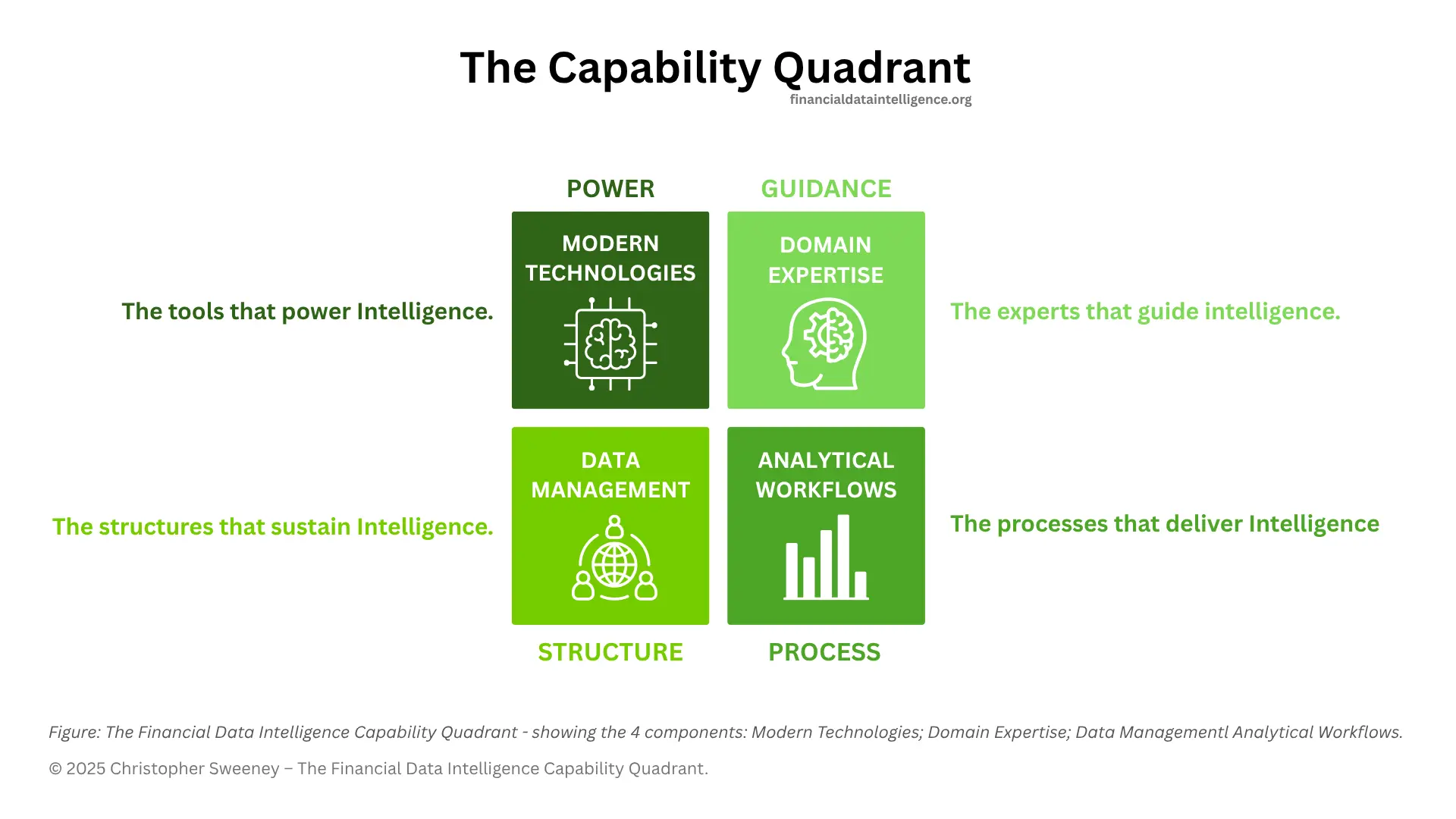
The Capability Quadrant
Financial Data Intelligence operates through four interconnected capabilities, each essential for turning data into
decision-ready intelligence:
1. Modern Technologies
"The tools that power intelligence."
Cloud infrastructure, artificial intelligence, advanced analytics, and data orchestration tools provide the
computational scale and agility to process complex, high-volume datasets, supporting human expertise in
generating actionable intelligence.
2. Domain Expertise
"The experts that guide intelligence."
Financial professionals and data specialists apply contextual understanding, experience, and judgment to
interpret patterns and insights with precision and relevance, working collaboratively with AI to elevate
decision-making.
3. Data Management
"The structures that sustain intelligence."
Rigorous processes for collecting, cleaning, integrating, and securing data establish the foundation of
accuracy, consistency, and trust - ensuring that intelligence is built on reliable information.
4. Analytical Workflows
"The processes that deliver intelligence."
Structured frameworks for modelling, reporting, and continuous monitoring translate raw information into timely,
actionable intelligence, enabling organisations to make smarter, faster, and more confident decisions.
Together, these four elements form the Capability Quadrant - the operational framework that powers Financial Data
Intelligence in practice, guiding organisations to systematically produce better intelligence and drive measurable
impact.
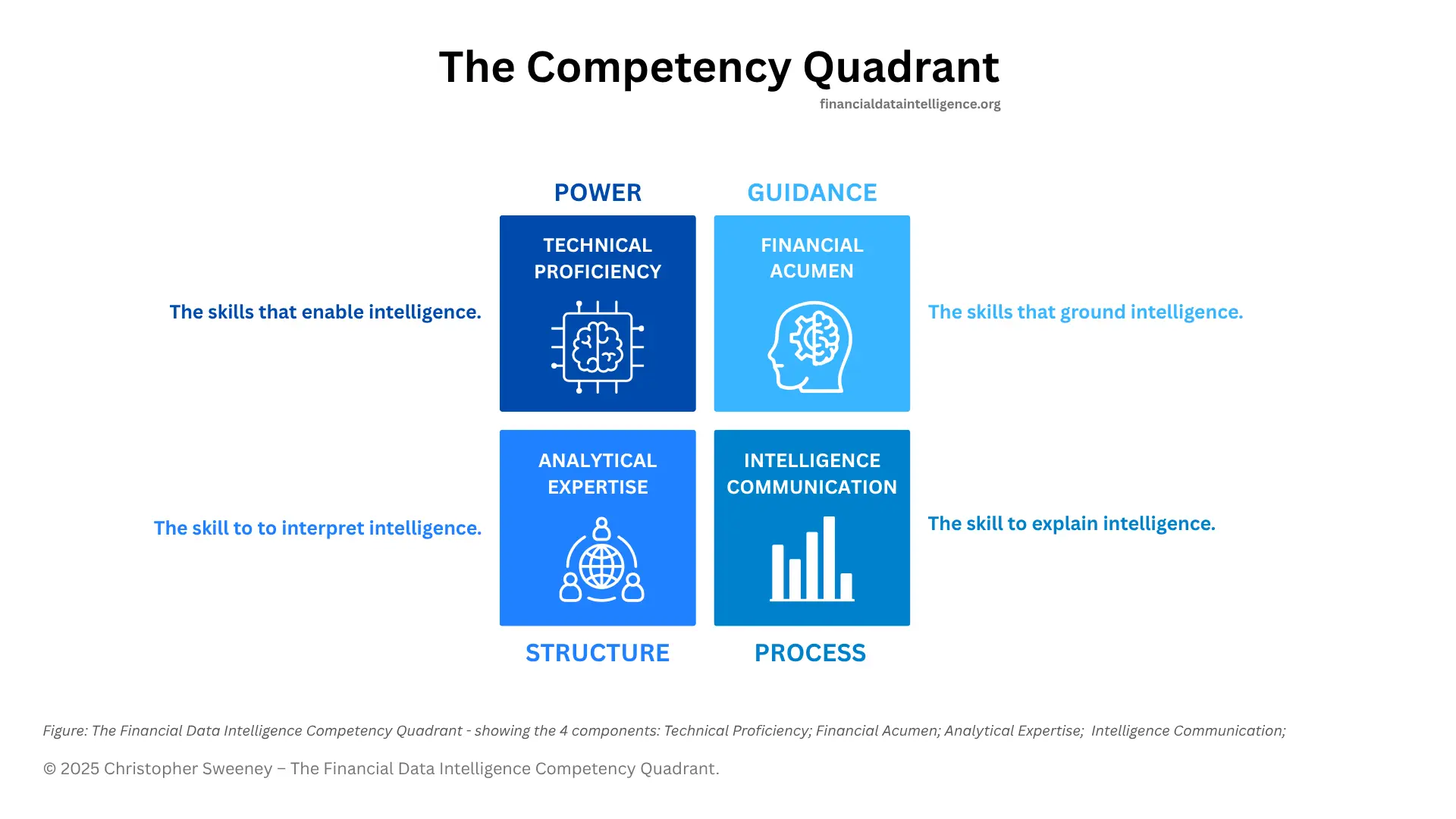
Financial Data Intelligence relies on a set of core competencies that empower individuals - and increasingly, AI
systems - to turn data into insight and action:
1. Technical Proficiency
"The tools and systems that enable intelligence."
Mastery of modern technologies, analytics, and AI workflows allows humans to collaborate with machines,
transforming complex financial data into actionable insights.
2. Financial Acumen
"The knowledge that grounds intelligence."
Deep understanding of financial principles, performance metrics, and business operations ensures insights are
connected to real-world decisions and strategic objectives.
3. Analytical Expertise
"The skill to interpret and validate intelligence."
The ability to analyse patterns, detect anomalies, and synthesise diverse data streams enables professionals to
generate reliable, meaningful intelligence.
4. Communicating Intelligence
"The skill to turn insights into actionable understanding."
The ability to clearly explain findings, combine evidence with narrative, and guide stakeholders ensures
intelligence is understood and applied effectively to drive decisions and outcomes.
Together, these four competencies form the Competency Quadrant - the human and hybrid human-AI capabilities that
make Financial Data Intelligence actionable, strategic, and impactful.
Financial Data Intelligence (FDI) replaces traditional data practices with a living, adaptive system that turns
information into strategic intelligence, empowering organisations to act faster, smarter, and more confidently. Here
are ten ways it can be applied in practice:
1. Budgeting & Forecasting
Challenge: Traditional budgets and forecasts struggle to account for
complex, dynamic factors across the organisation.
Solution: By integrating diverse datasets and applying AI-enhanced
modelling, FDI creates accurate, adaptive forecasts.
Impact: Finance teams can plan revenue, costs, and growth proactively,
making data-driven decisions with confidence.
2. Cost Management & Efficiency
Challenge: Organisations often lack visibility into hidden costs,
inefficiencies, and resource bottlenecks.
Solution: FDI analyses financial and operational data collaboratively with
human expertise, uncovering inefficiencies and optimisation opportunities.
Impact: Resources are allocated effectively, costs are reduced, and
operational efficiency improves measurably.
3. Risk Management & Compliance
Challenge: Risks and compliance gaps can escalate before traditional
monitoring detects them.
Solution: Continuous AI-assisted monitoring and analysis detect anomalies
and emerging threats across multiple datasets.
Impact: Organisations can act early to mitigate financial, operational, and
regulatory risks.
4. Investment Analysis & Strategic Decisions
Challenge: Identifying high-impact opportunities requires synthesising
diverse, complex data streams.
Solution: FDI combines domain expertise, AI insights, and advanced
analytics to evaluate opportunities and guide capital allocation.
Impact: Executives can prioritise initiatives strategically, maximising
return and impact.
5. Performance Monitoring & Reporting
Challenge: KPIs and performance metrics can be siloed, delayed, or
difficult to interpret.
Solution: FDI consolidates real-time data into intuitive dashboards and
continuous reporting workflows.
Impact: Decision-makers gain visibility, enabling timely, data-driven
interventions across the organisation.
6. Data Pipeline Automation
Challenge: Manual data collection and integration are time-consuming and
error-prone.
Solution: Automated data pipelines ingest, clean, and integrate financial
and operational data at scale.
Impact: Teams access accurate, up-to-date information, freeing human
expertise to focus on analysis and action.
7. Data Lake Implementation
Challenge: Disparate datasets make analysis slow, fragmented, or
inconsistent.
Solution: FDI consolidates structured and unstructured data into unified
repositories, ready for exploration and AI-enabled modelling.
Impact: Analysts and AI systems can work on a trusted, comprehensive
dataset, generating deeper insights faster.
8. Machine Learning & AI Applications
Challenge: Isolated AI experiments often fail to deliver actionable
results.
Solution: FDI integrates AI into structured workflows, combining human
judgment and machine intelligence for predictive insights and anomaly detection.
Impact: Organisations gain scalable, reliable intelligence that
continuously improves with new data.
9. Scenario Planning & Stress Testing
Challenge: Organisations struggle to anticipate the impact of market shifts
or internal changes.
Solution: FDI enables “what-if” modelling using integrated data and
AI-driven simulations.
Impact: Leaders can assess resilience, guide contingency planning, and make
confident, informed strategic choices.
10. Fraud Detection & AML
Challenge: Suspicious transactions and compliance violations can go
unnoticed until it’s too late.
Solution: FDI applies AI-assisted monitoring to detect anomalies and flag
potential risks in real time.
Impact: Organisations protect assets, reduce losses, and safeguard
operational integrity.
These examples illustrate that FDI is not just a set of tools - it is a systematic, adaptive practice. By embedding
it into everyday operations, organisations gain foresight, accelerate decision-making, and create sustainable
competitive advantage in a fast-changing financial landscape.
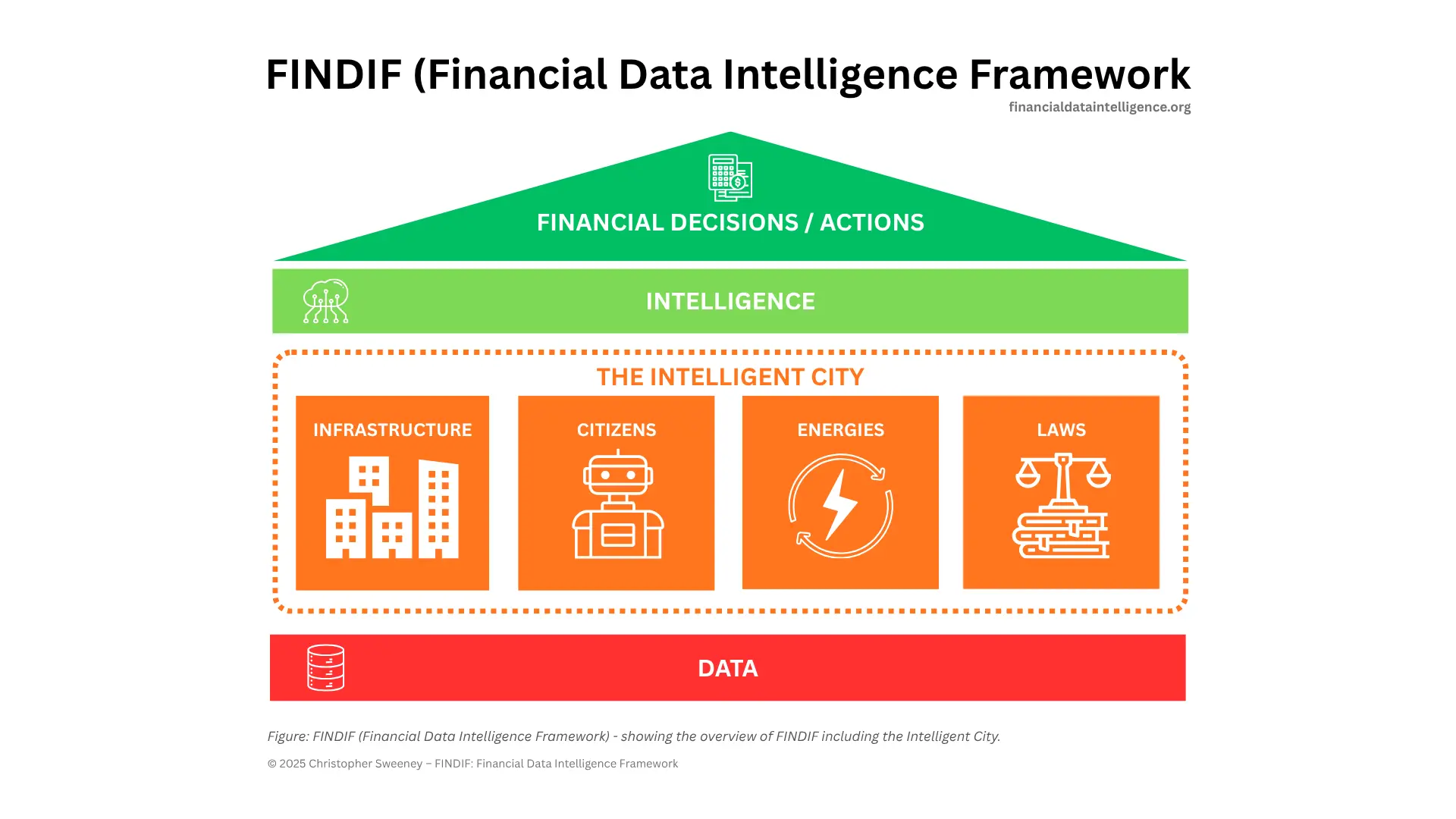
FINDIF – Financial Data Intelligence Framework
FINDIF is a structured capability
framework for business leaders seeking to build a sustainable Financial Data Intelligence capability within their
organization.
It establishes a common language and operating model, defining how people, processes, and platforms
work together to create, protect, and apply data for superior financial decision-making.
FINDIF visualises this as an Intelligent City, built on four integrated Pillars:
Infrastructure – The secure, scalable backbone for collecting,
integrating, and analysing data.
Citizens – The domain experts who transform raw data into actionable
intelligence.
Energies – The cultural, organisational, and technological forces that
accelerate FDI adoption.
Laws – The principles, standards, and governance mechanisms that ensure
data quality, ethical use, and sustainability.
Together, these Pillars form a holistic framework that aligns technology, data management, governance and financial
expertise under a unified vision for intelligence-driven financial decisions.
Learn more at FINDIF.org
Measuring the Impact of Financial Data Intelligence
The ultimate measure of Financial Data Intelligence is confidence - the ability to make decisions quickly and
decisively because you trust the intelligence behind them.
While metrics like forecast accuracy or efficiency gains are useful, they are secondary to a deeper shift: reducing
uncertainty. When FDI is working, leadership decisions feel less speculative and more evidence-driven.
1. Confidence in Decision-Making
Track how decision-making speed, consensus, and reversal rates evolve over time. As data quality and
intelligence improve, decisions require less debate and fewer course corrections.
2. Accuracy and Confidence in Forecasting
Compare model confidence scores and human confidence levels against actual outcomes. The closer they align, the
stronger the organisation’s collective trust in its intelligence systems.
3. Cost Savings and Efficiency Gains
Monitor how early FDI insights trigger proactive actions - reallocating budgets, mitigating risks, or seizing
opportunities. True intelligence isn’t about knowing more; it’s about acting earlier with conviction.
Many business leaders become fixated on how fast or how much. But in strategic finance, the most critical metric is
how confident you are in your decisions. Although difficult to quantify, the true measure of Financial Data
Intelligence is how much uncertainty it replaces with clarity.
FDI matures when decisions no longer feel like bets, but well-informed moves supported by evidence. The real ROI
isn’t just speed or savings - it’s confidence.
Summary
Financial Data Intelligence (FDI) is more than tools or reports - it’s a practice that transforms how organisations
make financial decisions.
With FDI, organisations can:
Turn data into actionable intelligence through collaborative human-AI
expertise.
Make confident decisions grounded in high-quality insights, not guesswork.
Adapt continuously, creating a living system of intelligence that improves with
every cycle.
Drive real impact, from optimised resources and accurate forecasts to smarter
strategy and innovation.
By embedding FDI across people, processes, and technology, companies move from reacting to anticipating - replacing
uncertainty with clarity and intelligence with action.
FDI empowers leaders, analysts, and teams to act decisively and strategically, giving organisations a sustainable
competitive advantage in a fast-moving financial world.
Next Steps
Financial Data Intelligence (FDI) is a practice, not a one-off project. To start turning your data into actionable
intelligence:
Explore FINDIF: Understand how the framework can guide your organisation in building a
sustainable, systematic FDI capability.
Assess Your Current State: Identify key financial decisions that could benefit from better
intelligence, and evaluate your data, processes, and team readiness.
Start Small, Scale Thoughtfully: Begin with a high-impact decision where improvements can be
clearly measured, then expand as your confidence and capability grow.
Subscribe for Insights: Stay up-to-date with FDI best practices, practical examples, and expert
guidance by subscribing to updates, articles, and resources.
By following these steps, organisations can progressively embed FDI into everyday operations, increasing confidence,
reducing uncertainty, and unlocking the full value of data-driven financial decision-making.
Further Reading & Resources
Explore more about Financial Data Intelligence, best practices, and related insights. These resources provide
additional context, frameworks, and practical guidance for embedding FDI in your organisation.
Check back regularly - this list will grow as we publish new articles, videos, and practical case studies on
Financial Data Intelligence.
Frequently Asked Questions about Financial Data Intelligence (FDI)
1. Is Financial Data Intelligence just another
name for financial analytics?
Not quite. Financial analytics focuses on analysing past data to understand what happened. FDI goes further - it
combines analytics, AI, and domain expertise to generate actionable intelligence that guides what to do next.
2. Can I buy FDI as a product or software?
No, FDI isn’t a single product you can buy. It’s a practice that integrates people, processes, and technology to
turn data into trusted, decision-ready intelligence. Software supports it, but it’s not the whole story.
3. Is AI required for FDI?
Yes. AI is inherent to Financial Data Intelligence. It works alongside human expertise across all aspects of the
practice - improving data quality, uncovering insights, and continuously enhancing intelligence - making FDI
fundamentally different from traditional financial analytics.
4. Is FDI only for big companies with large
data teams?
Not at all. Organisations of any size can build Financial Data Intelligence practices. Even small businesses
benefit from making faster, smarter, data-driven decisions.
5. Does FDI replace the need for human
judgment?
Never. FDI enhances human judgment by providing accurate, real-time intelligence. It equips decision-makers with
clarity and confidence - but the final call always rests with people.
6. Is Financial Data Intelligence just about
financial data?
No. FDI combines financial and non-financial data - from operations, markets, HR, customers, and more - to
provide a complete picture of performance and opportunity.
7. Is FDI a one-time project or implementation?
FDI is an ongoing practice. It evolves as your business, data, and technologies change. The intelligence you
build today should continuously improve as new data arrives.
8. How does FDI support compliance and
governance?
FDI strengthens governance and compliance indirectly by improving data quality, traceability, and transparency -
but its true goal is strategic intelligence, not box-ticking.
9. Can Financial Data Intelligence really
deliver a competitive edge?
Absolutely. Businesses that can transform raw data into fast, reliable insight make better strategic decisions -
spotting opportunities and risks before their competitors do.
10. Where should an organisation begin with
FDI?
Start with a high-value decision that currently involves uncertainty or friction. Build strong data foundations,
processes, and collaborative human-AI workflows around it, then scale the practice gradually. Early wins in
important decisions create momentum and demonstrate the transformative potential of FDI.
About the Author
Chris Sweeney is a seasoned finance and
data professional with over 20 years of experience helping organisations turn complex data into actionable
intelligence. With a background spanning finance, analytics, and AI-driven decision-making, he has built and
overseen systems that combine human expertise with advanced technologies to drive smarter, faster, and more
confident financial decisions.
Chris believes that the future of finance lies in collaborative intelligence - where people and AI work together
seamlessly to transform data into strategic advantage. Through his work on Financial Data Intelligence (FDI) and the
FINDIF framework, he helps organisations of all sizes establish systematic, sustainable practices that deliver
measurable impact while reducing uncertainty in decision-making.
By sharing his experience, frameworks, and practical insights, Chris empowers leaders, analysts, and teams to build
living financial intelligence capabilities that evolve with their organisations, creating a decisive advantage in an
increasingly complex and fast-moving world.
For more about Chris's work and insights across finance, analytics, and AI, visit sweenc.com.
Join the Financial Data Intelligence Community
Stay up to date with the latest insights, articles, and guides on Financial Data Intelligence. Get updates straight
to your inbox.